I love finding inspiration online. There’s so much beauty and creativity out there. But lately I’ve realized something—I’ve gotten really good at saving inspiration, but not necessarily doing anything with it.
I looked at my saved folder on Instagram—the one with hundreds of images I was supposedly going to reference later—and realized I couldn’t remember saving most of them. And that made me a little sad, because at some point, each of those images stopped me mid-scroll. They meant something for a second. But I never gave them the chance to mean something lasting.
Sound familiar?
The Inspiration Paradox
We have more access to art and inspiration than any generation in history. I can pull up the entire collection of the Met on my phone while sitting on the couch. That’s incredible! But here’s what I’ve noticed—our creative wells feel full, but somehow shallow. We’re taking in so much, but retaining so little.
We scroll through hundreds of images a day. We have Pinterest boards with thousands of pins we never revisit. We see what’s trending, but we don’t always know who made it or why.
I think this is why it’s possible to feel overwhelmed but uninspired at the same time. We’re seeing the surface of things, but missing all the layers underneath.
What If We Slowed Down?
I started thinking about how artists used to learn. Before the internet, before Pinterest—artists would travel for days just to see a single painting. They’d stand in front of it for hours. Sketching, studying, absorbing. One painting. For hours.
Now we see thousands of images before breakfast and forget them by lunch.
There’s this quote by Anne Morrow Lindbergh that’s been on my mind: “One cannot collect all the beautiful shells on the beach. One can collect only a few, and they are more beautiful if they are few.” What if the real magic isn’t in how much inspiration we collect, but in going deeper with what we already have?
What if the answer isn’t more inspiration—it’s slower inspiration?
The Slow Inspiration Practice
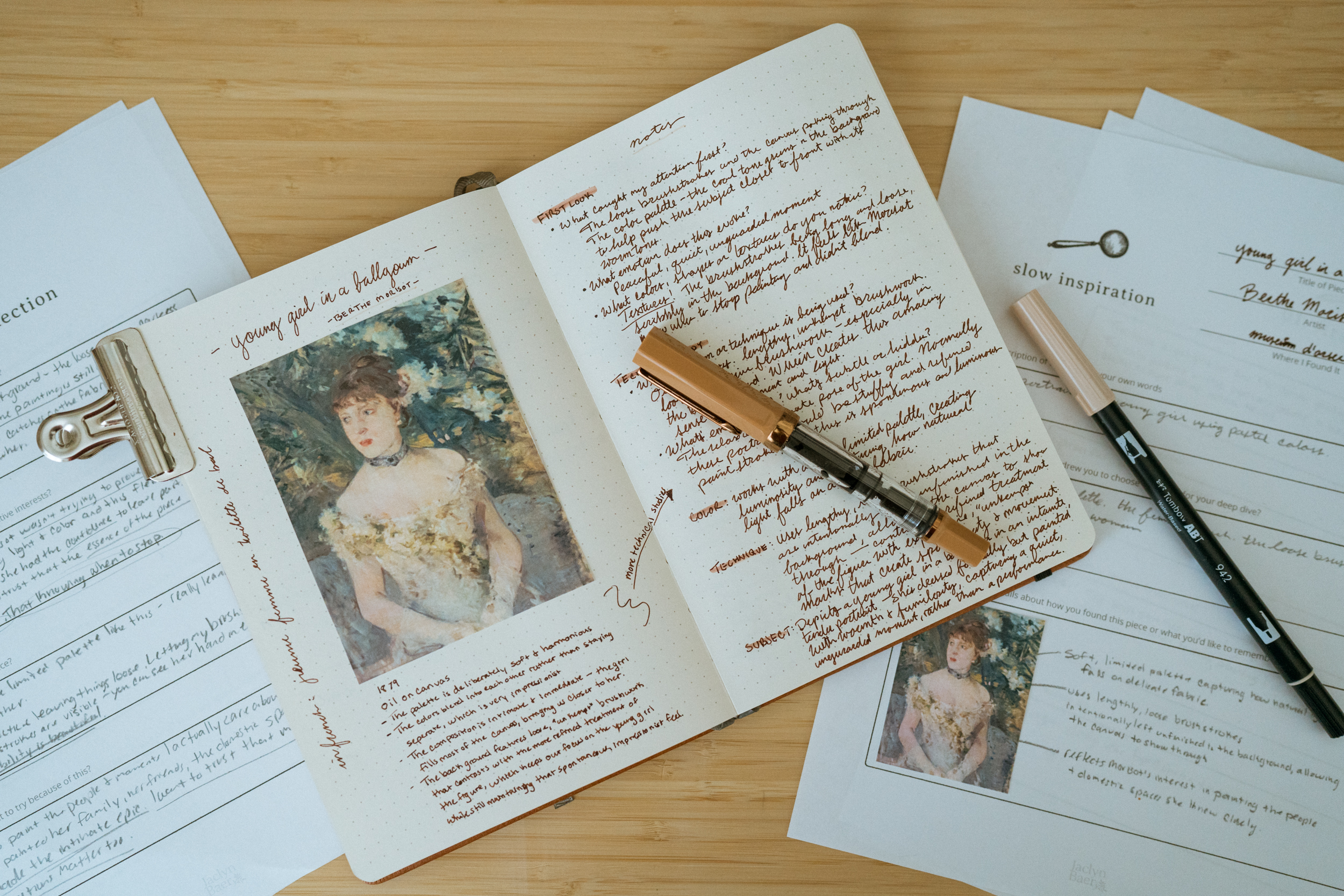
So here’s what I’ve been trying. Instead of saving everything that catches my eye, I choose ONE piece of art—or an article, or a short film, or whatever moves me—and I spend real time with it. Not a glance. Not a quick save. I actually study it. I research the artist. I notice the details. I let it linger with me over days or even weeks.
It’s like rereading a favorite book and catching themes you missed the first time. Or rewatching a film and suddenly noticing the cinematography. Or listening to an album on repeat and hearing instruments you never noticed before.
The goal is to transform passive consumption into active learning. To fill your creative well with substance, not just volume.
And honestly? There’s something really beautiful about choosing one piece of art and saying—this one matters to me. I’m going to spend time with this. I’m going to let this teach me something.
Three Ways to Practice
Weekly Deep Dive: Choose one piece per week and spend 15 to 20 minutes with it multiple times throughout the week. Maybe Monday you just look at it and notice your first impressions. Wednesday you research the artist. Friday you think about how it connects to your own work.
Monthly Muse: This is for when you find something that really speaks to you. Spend a whole month with one piece. Research deeply. Create something inspired by it. By the end of the month, you know this piece intimately.
The Trilogy Approach: Choose three pieces that feel connected—maybe same artist, same era, same theme—and spend a week with each. By the end of the month, explore the thread between them. You’re building a little constellation of meaningful work.
Going Deeper: The Five Looks
To help you actually do this, I created a worksheet with questions to guide you through each piece you choose. Here’s a quick overview of how it works:
First Look is all about immediate response. What caught your attention? What emotion does this evoke? Just your gut reaction.
Second Look is more technical. What medium is being used? What choices did the artist make with color, composition, texture? What’s emphasized versus what’s subtle?
Third Look is about context. Who made this? What’s their story? When was it made? What was happening in the world or in their life?
Fourth Look gets personal. Why did this stop you in the first place? How does it connect to your own work? What can you learn from it?
Fifth Look is about building connections. What other works does this relate to? Can you trace a lineage of influence?
And then there’s a bonus step—create something in response. Sketch something inspired by it. Write about it. That cements the connection in a way that just looking never can.
Practical Tips
Create a separate “Deep Dive” folder. This is not your regular saves. This is sacred. Only things you’re genuinely committing to study go in here.
Set a weekly art date with yourself. Just like an artist date from The Artist’s Way, but specifically for sitting with your chosen piece. Block off 20 minutes. No distractions.
Use a physical notebook. Write your observations by hand. There’s something about the slowness of handwriting that matches the slowness of this practice.
Let the research rabbit holes happen. Finding out who influenced your artist, then wanting to explore that artist? That’s not getting distracted—that’s the point. Follow the threads.
Let it inform your actual work. Try a technique you noticed. Use a color palette that inspired you. Reference the composition in your own piece.
Watch the Video
I made a video walking through this whole practice in more detail. If you’re a visual learner or just want to hear me ramble about this topic a bit more, check it out:
What to Choose
You might be wondering—what should I actually choose for this? The answer is: whatever genuinely moves you.
It could be a painting from a museum’s online collection, a spread from an art book you already own, or a single illustration from an artist you follow. It could be a short film, a music video with strong visuals, a poem, or an interview with someone you admire.
The key is: choose something that genuinely sparked something in you. Not something you think you should study. Something that actually made you feel something.
Final Thoughts
If you’ve been doing morning pages or artist dates from The Artist’s Way, this practice fits right in. Your morning pages are a great place to process what you’re noticing about your chosen piece. And your weekly deep dive could literally be your artist date.
It’s about presence. It’s about depth. It’s about letting things linger with you long enough to actually change you.
I’d love to know—what’s one piece of art that has stuck with you? Something you keep coming back to? Maybe it’s something you could do a deep dive on this week. Tag me on Instagram and let me know!